
Infrastructure investment has long been a significant asset class for Development Finance Institutions (DFIs) in emerging and developing countries, primarily focusing on sectors such as roads, power, and sanitation. In recent years, DFIs have also begun investing in digital infrastructure, particularly in tower infrastructure to enable universal mobile connectivity. However, the increasing demand for data centers in emerging markets is creating pressure on power supplies. Could these markets benefit from a synergy of combining data center and power investments, and would this have an impact on achieving universal power access to meet Sustainable Development Goal 7 (SDG7)?
While universal access to power and connectivity is improving, demand is growing rapidly in emerging markets and developing economies. An estimated one-third of the population, or 2.6 billion people[1], remain unconnected or underserved, and 760 million people, mostly in Africa, still lack access to electricity, with approximately 589 million in Africa alone[2]. The challenge goes beyond simply connecting more people to the power grid; it also involves transitioning to cleaner energy sources. Coal still makes up around 36% of the global energy mix. In 2023, investments in the energy sector amounted to approximately USD 2.8 trillion, with USD 1.8 trillion directed toward clean energy[3].

Data centers will play a pivotal role in both power demand and connectivity. We are quickly transitioning from enterprise and colocation data centers to facilities owned or leased by hyperscalers (who account for 40% of the market) that offer cloud and AI services. AI, in particular, is driving demand for higher and denser computing (up to 36.1 kW per rack[4]). These power-hungry hyperscale data centers will require massive amounts of energy, ranging from 200 MW to 1 GW per campus. The top four hyperscalers — Amazon ($17.6B), Microsoft ($13.9B), Alphabet ($13.2B), and Meta (Facebook, $8.2B) — accounted for around 80% of data center spending in the second quarter of 2024[5].

Power is currently the biggest bottleneck in data center supply, as they compete for the same power equipment needed for green energy transitions and the deployment of electric vehicle charging infrastructure. Challenges are particularly acute in high-density data center markets such as Northern Virginia, where also power transmission limitations exist. As a result, some data centers are exploring the possibility of self-supplying power by colocating near energy sources or developing their own generation capacity.
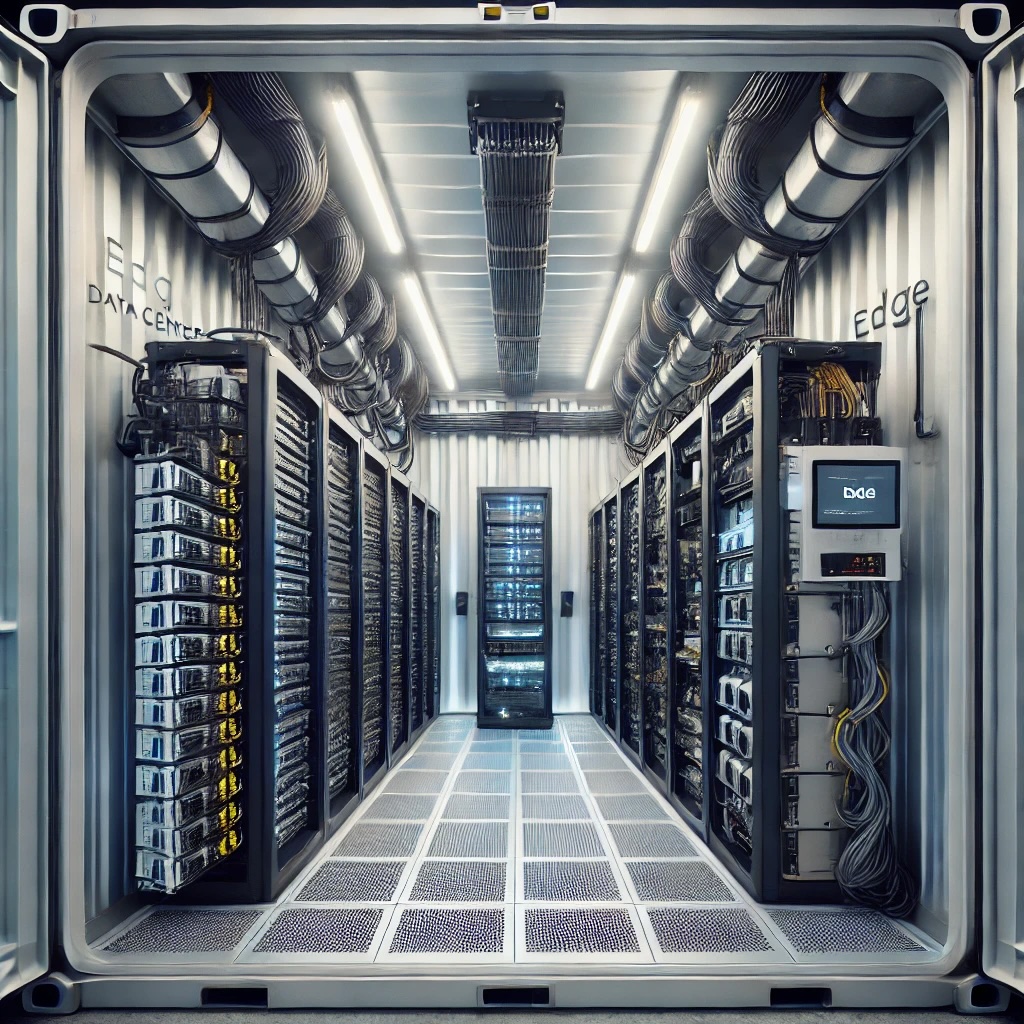
Training AI is highly energy-intensive, and while the large-scale infrastructure required for such tasks can be planned and built centrally, edge data centers are becoming more viable. These smaller facilities handle AI inference workloads that require lower latency and a more distributed network of data centers. Such facilities also need distributed power, particularly in emerging and developing markets. While this could increase local power demand, it also presents an opportunity for these data centers to contribute to local energy supplies, possibly through mini-grids. The International Energy Agency predicts that by 2030, 30% of Africa’s universal electricity access will come from mini-grids.

Several challenges must be addressed to enable the successful development of these data centers:
- Data Sovereignty and Privacy: As AI data centers for training are built outside national borders and AI inference workloads are processed in distributed edge data centers within local markets, maintaining data sovereignty and privacy will be crucial.
- Transitioning to Clean Energy: Data centers must transition to clean energy sources, with the right combination of power supplies tailored to their specific demands. Solar and wind power may help supplement this transition, but eventually, geothermal energy and small modular reactors (SMRs) should be considered.
- Regulatory Barriers: Regulations, especially around SMRs, will be a significant hurdle. There may be opposition, particularly in urban areas where edge data centers are more likely to be located. However, SMRs are not comparable to older nuclear technologies like Chernobyl. For instance, the first certified NuScale reactor is designed to be safer and more efficient, eliminating the need for Class 1E safety-related power, emergency diesel generators, or core coolant pumps post-accident, while also reducing the need for control room staffing[6].
- Economic Impact: Data centers can bring substantial economic value to communities by creating jobs and requiring a workforce that must be reskilled. For example, artisans, construction workers, plumbers, and electricians may need to be upskilled to build and maintain the cooling and power systems of data centers and can come direct from the communities.
- Connectivity: The third leg of the trifecta is connectivity. Sufficient capacity must be available to connect these data centers, and doing so should lower the cost per megabyte consumed for everyone.
Looking Ahead
I believe that synergies can be achieved by combining investments in both data centers and power generation. Investing in both demand and supply allows investors to hedge their investments. DFIs are already naturally inclined to invest in both sectors, and now is the time to mobilize private capital from those who need it most — the hyperscalers. DFIs and hyperscalers should collaborate on concessions to fund both sides (data centers and power) of combined projects. Treating it like an Indefeasible Right of Use (IRU), similar to how the telecommunications industry funds capital projects like submarine cables, could accelerate deployment. For instance, hyperscalers could front the upfront costs and could commit to long-term lease-back agreements (10 to 15 years) for a certain amount of megawatt consumption, speeding up the timeline for new projects. Investigating the use of SMRs, which are much more efficient and cleaner in generating energy, and contributing power back to the grid using mini-grids could also be beneficial, but the barrier with regulations will be a challenge.
[1] World Bank Digital Overview
ITU Universal and Meaning full connectivity.
[2] IEA – Access to Electricity
[5] Webscale Network Operators: 2Q24 Market Review – MTN Consulting (mtn-c.com)
[6] Federal Register :: NuScale Small Modular Reactor Design Certification
 knowledge
Leave a comment